가장 많이 본 글

레이블이 What to do in Korea인 게시물을 표시합니다. 모든 게시물 표시

2013년 11월 25일 월요일

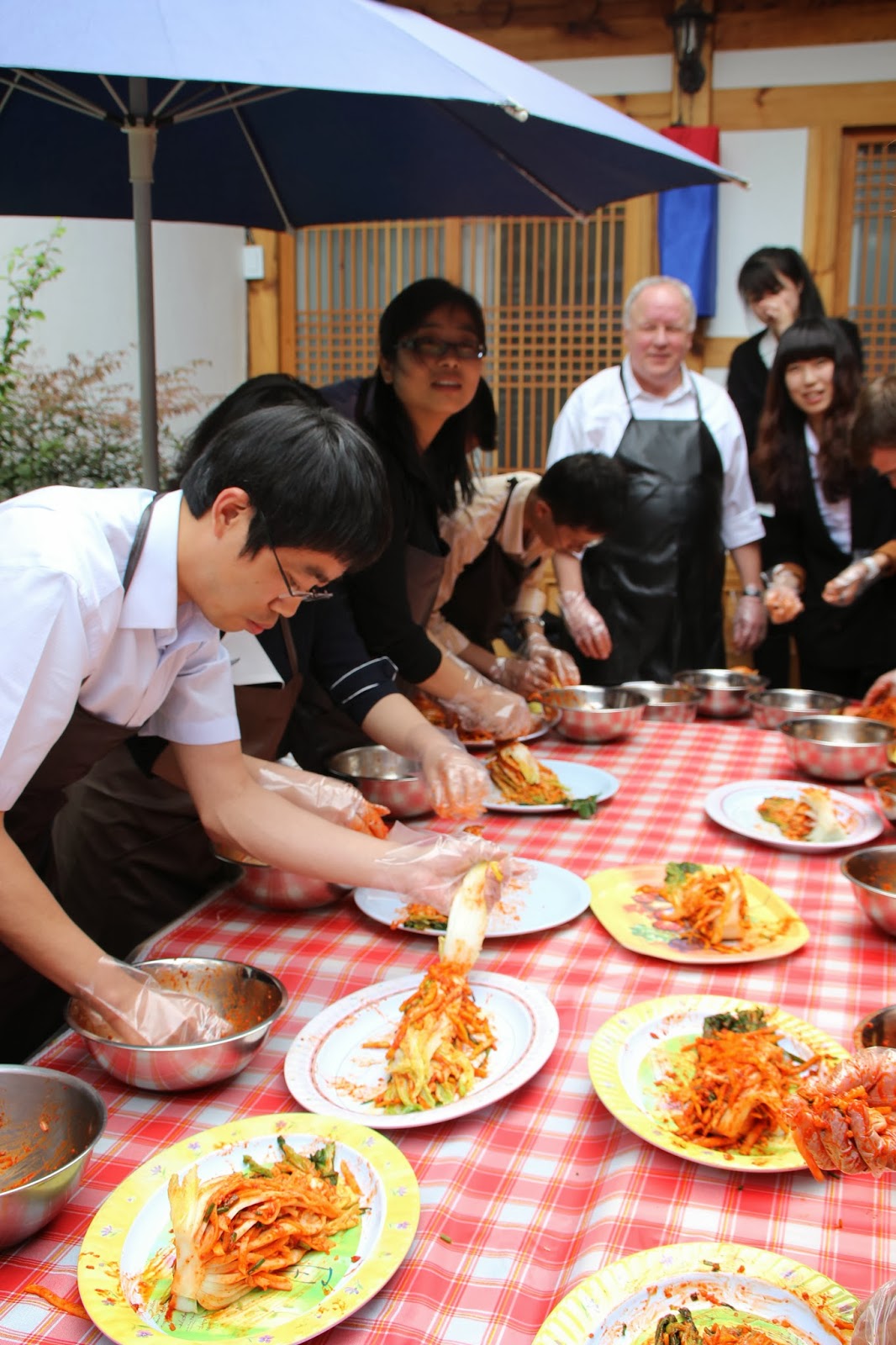
Kimchi and Making Kimchi Class


Experiencing Korean culture.

A unique experience into tea ceremony, Joseon’s high culture

and making and tasting kimchi, Korea’s representative food.

You can also learn Korean traditional manners and try on Hanbok,

Korean traditional clothing


 Kimchi, the staple Korean food, was named as
                                        one of the world’s five healthiest foods
                                              
                        by Health Magazine in the United States recently.


In the March online edition, the U.S. magazine recommended its readers to incorporate the spicy fermented cabbage dish into their diets for its bacteria lactobacilli, also found in yogurt, as well as its high content of vitamins A, B and C.
Citing recent studies, the magazine said the healthy bacteria in kimchi can prevent yeast infections, help with digestion and may also help prevent cancer.
 
It also provided readers with a few cooking tips, such as scrambling eggs or topping a baked potato with kimchi.
Other foods to make the magazine's top five list were Spanish olive oil for heart disease prevention and Japanese soy sauce for
prevention of cancer and osteoporosis.
Greek yogurt was also selected for its many health benefits, including enhancing immunity, improving lactose intolerance and
stronger bones.
Lentils from India were recommended for their high content of protein, cholesterol-lowering soluble fiber and iron.


Contact Us for Making Kimchi Class : Send E-mail


2013년 11월 20일 수요일

Skiing in Korea

Snow Angels


Skiing in Korea


If you’re into skiing, snowboarding, spas, festivals or just want to take in the gorgeous landscape, Korea is the perfect place for winter fun and adventure. The ski resorts are some of the finest in the world and attract thousands of tourists each year. Many are located in Gangwon-do Province, which is known for its abundant snowfall. Here, resorts are equipped with the latest facilities, a great range of slopes and superb accommodation. The peak ski season starts mid-December until the end of February. You’ll also find many ski resorts remain open all year round. When visiting, make sure you check out the annual ‘Ski and Snow Festival’ and take part in a tour of the popular ‘YongPyeong’ and ‘High 1’ ski resorts. Each tour lasts four days, and includes accommodation, meals, and lessons with hands on programs plus an exciting skiing and snowboarding competition. What’s more, there’s traditional Korean singing, dancing and of course, the beautiful mountain scenery to take in. So, if you’re searching for an adrenaline-packed holiday or quality family time in snow, Korea is ready to welcome you in winter.
 
Ski tour program : Click~! Ski tour
 
Contact us : Send E-mail
 

The Ski season is coming~!!


Korean Ski season is coming~! Ski tour in Korea~!!

Contact us : Send E-mail


Most Popular Ski resort:


2013년 11월 19일 화요일

Korean Traditional Costume - Hanbok

Experience wearing Hanbok program : Click~! Korean culture tour


The Hanbok is the traditional outfit of the Korean people. Koreans nowadays wear this outfit only on festive days or special anniversaries, however it was worn daily up until just 100 years ago. It is a kind of traditional formal dress and most Koreans keep a hanbok for these special times. Children wear hanbok on their first birthday and adults wear it for their wedding ceremony and on their 60th birthday. The hanbok is also worn for funerals or religious services, and is still used as casual wear in villages or districts where the traditional ways of life are still maintained such as Chunghak-dong on Mount Jirisan.


One way to refer to Korea is 'the people in white’, which refers to the fact that the Korean people often wear white or similar tones. Koreans have long worn white clothing made of hemp or cotton regardless of their status. The case of formal dress was different, however. Color and design were typically luxurious and the hanbok was particularly highly valued for its gracious and subtle colors. Modern designers have presented the traditional Korean costume at renowned cities of fashion such as Paris and New York.


The hanbok is colored using natural dyes. The colors of nature are imbued in the cloth. For example, red dye is obtained from the petals of red flowers. The color pigment is extracted by grounding the petals in a mortar, putting them in a jar and rinsing them with hot caustic soda. It is a very slow, complicated, precise process. The colors obtained in this way differ greatly from artificial dyes in their color and depth. The Hanbok is creative and emotional in its design. One Korean phrase regarding the shape of the outfit is the 'upper is narrow, lower is wide'. The jacket must be tightened and the skirt relaxed, as was the silhouette of the women’s hanbok in Joseon times. The tightly fitting jacket attractively reflects the shape of the upper body. The wide sleeves and flexible skirts enhance the wearer’s gracefulness by hiding the physical features of the lower body.


The principles behind the creation of the hanbok can be explained by the movement from 2 dimensions to 3 dimensions. The flat cloth is patterned, cut, and sewn in 2 dimensions but the subject wearing the hanbok is a 3 dimensional being. The hanbok is frilled or fastened with string to enhance the 3D affect. The unique line of the hanbok is created from this process. The lines of the hanbok costume are as smooth as the curves of the eaves of tiled roof house and as sharp. An old adage says that you can tell the man by his clothes.


Koreans have traditionally lived as one with nature, and obtained all material from natural sources for making cloth and coloring it. Koreans favor smooth curves rather than straight lines and that has added a gracious line to the hanbok. A common comment that every hanbok designer gets is that the outfit is more beautiful when it is worn than when it is on the hanger, and more beautiful when moving than when standing. Indeed, the unique lines of the hanbok appear at their greatest when the wearer is in motion.

Although hanbok have become the ritual dress of choice worn only on traditional holidays, Koreans' love for hanbok is tremendous. The popularity of Korean classic dramas is causing many foreigners to take a keener interest in traditional Korean attire as well.


Contact us : Send E-mail

Nami Island (winter sonanta) and Jade Garden (The winter, the wind blows)


Nami IslandNamiseom Island was formed as a result of the construction of the Cheongpyeong Dam. It is a half moon shaped (462,809㎡) isle, and on it is the grave of General Nami, who led a great victory against the rebels in the 13th year of the 7th king of the Joseon Dynasty, King Sejo (reign 1455 ~ 1468). Namiseom Island is 63 km away from Seoul in the direction of Chuncheon, and is famous for its beautiful tree lined roads. The island is 30 minutes away from Chuncheon and an hour away from suburbs of Seoul. Since it is not far from Seoul, many couples and families come to visit.
 
 
A special feature of Namiseom Island is that there are no telephone poles. This is because all electric wires were built underground to keep the natural feeling of the landscape. The complex is 553,560 square yards with chestnut trees and poplar trees around the isle. In the middle of the isle, there is a grass field about 316,320 square yards. It is composed of education and training facilities, camping sites, swimming pools and water-sports facilities for motorboats and water skiing. There is also a theme park with merry-go-rounds, a shooting range, roller skating rink, and there are lodging facilities such as resort villas and bungalows.
 
 
Winter SonataWinter Sonata (Hangul: 겨울연가; RR: Gyeoul Yeonga; also known as Winter Love Story or Winter Ballad) is a South Korean television drama series broadcast by KBS in 2002. It is the second part of the Endless Love installment directed by Yoon Seok-ho. It stars Bae Yong-joon and Choi Ji-woo.
It was broadcast on Japan's NHK and has been a major part of the Korean wave both there and throughout Asia. Filming also took place on the resort island of Namiseom. It has also been adapted into an anime series which aired in October 2009.


Jade Garden, created under the theme of ‘Small Europe in the Forest,’ is located near Jade Palace Golf Club on a plot of land measuring 160,000 square meters. The 24 distinctively-themed areas in the garden boast a total of 3,000 plant species including rhododendron, maple trees, irises, and blueberry bushes as well as patches of thick, natural forests. The arboretum makes the most out of its natural valley topography and presents visitors with a mix of tidy gardens, graceful flowers, and an array of European-style architecture.
 
 
For the convenience of its guests, Jade Garden operates a Tuscan-style visitor’s center where patrons can enjoy a simple snack or beverage and purchase souvenirs. Three difference walking courses (each 2 hours in length) take visitors around the arboretum and there is even a gardening program in operation for aspiring gardeners.
 
 
That Winter, the Wind Blows (Hangul: 그 겨울, 바람이 분다; ) is a 2013 South Korean romantic melodrama television series starring Zo In-sung, Song Hye-kyo, Kim Bum and Jung Eun-ji. A gambler and con man (played by Zo) pretends to be the long-lost brother of a blind heiress (played by Song), but these two damaged people come to find the true meaning of love after meeting each other.


The series is based on the Japanese drama I Don't Need Love, Summer (愛なんていらねえよ、夏 Ai Nante Irane Yo, Natsu) that aired on TBS in 2002, and was previously adapted into the 2006 Korean film Love Me Not.  This 2013 Korean drama adaptation was written by Noh Hee-kyung and directed by Kim Kyu-tae.


Contact us : Send E-mail


Seasonal Festival in Korea - Hwacheon Mount Trout Ice Festival (Winter)

 
The Hwacheon Sancheoneo (Mount Trout) Ice Festival will be taking place in Hwacheon in Gangwon-do province. This virtually untouched region is known as the first area in Korea that freezes over in winter, and the river is covered with a thick layer of ice.
 
Visitors can try out ice fishing, and those who are feeling brave can try to catch mountain trout with their bare hands. As well as fun activities and performances, there is also an exhibition of ice sculptures that took 20 weeks to prepare. Visitors can sample raw and grilled mountain trout, both of which are delicious.
 
 
Sancheoneo Experience
Ice fishing (onsite registration/pre-booking), lure fishing, bare-hand fishing
 
 
Snow/Ice Experience
Ice sledding, bobsledding, ice football, eolgomiseong (tunnels, slides), snow sculptures, snow sledding, World Snowman Square, ice rink, ice train, snow train, cross country skiing, Nongmokjangchigi (mini ice hockey)
 
 
Photo and information by KTO (Korea Tourism Organization)
 
Contact us : Send E-mail


Best Activities (1) - Gangchon Rail Bike

Rail Bike Tour Program :  Click~! Rail bike tour


Where is the Gangchon?
The Gangchon Resort (강촌유원지) is a small village nestled along the Bukan River in Chuncheon, Gangwon-do Province. The river is on one side of the village, while Bongwhasan Mountain and Samaksan Mountain are on the opposite side making for beautiful scenery anywhere you look.
Gangchon Train Station is conveniently located near the entrance to the recreational area. Many young Koreans enjoy taking the romantic train ride to this cozy little village and for the past ten years this spot has also become a popular place for college students to go to on weekend trips. The village area has campgrounds, a youth hostel and other lodging facilities, bicycle paths, bungee jump facilities and many other recreational areas.


The Rail Bike
The rail bike in Gangchon is a new type of leisure sport that combines biking along a railway and scenic views. Rail bikes are commonly found in the mountainous regions of Europe. The sport makes use of an abandoned railway track that runs from Gangchon station to Kim Yu Jeong station. The total track is 8.2 kilometers long and is a continuous descent that is easy to ride along clean valley waters and crimson red foliage.
There are 2-person (110 kilograms) and 4-person rail bikes (138 kilograms). Despite its large size, a rail bike runs quite smoothly so it is sufficient for one person to pedal a 4-person rail bike at speeds of 10 to 30 kilometers per hour.
Ride at a slow speed of 15kph to enjoy the surrounding scenery. On the way back, you will return to Gangchon stn on a free bus for a comfortable ride with a view.


Contact us  :  Send E-mail

Voted 10 Attractions in Korea by the foreign tourists (4) - Insadong Antique Street

Seoul Tour Program : Click~! Seoul tour

Contact us  : Send E-mail


Insa-dong (인사동), located in the heart of the city, is an important place where old but precious and traditional goods are on display. There is one main road in Insa-dong with alleys on each side. Within these alleys are galleries, traditional restaurants, traditional teahouses, and cafes.


The galleries are the heartbeat of Insa-dong. There are about 100 galleries in the area and you can see every example of traditional Korean fine art from paintings to sculptures. The most famous galleries are Hakgojae Gallery, which functions as the center of folk art, Gana Art Gallery, which promotes many promising artists, and Gana Art Center.


The teahouses and restaurants are the perfect complement to the galleries. At first they might be hard to find, but if you take the time to stroll around the twisting alleyways, the window shopping in itself can be very entertaining. The shops in Insa-dong are very popular among all age groups, because each one is unique.


Every Saturday from 14:00 – 22:00 and Sunday from 10:00 – 22:00, some streets are blocked off from traffic and it becomes a cultural space. Stores set up booths outside and others set up shops (Korean candy merchants and fortune tellers.) There are traditional performances and exhibits as well. Insa-dong is especially popular with foreign tourists. This is where they can experience and see traditional Korean culture firsthand, and also purchase pieces of fine art. On the street you can eat Korean taffy and traditional pajeon (Korean pancake), and see many foreigners lost in all the joyous festivities of the street.


NLL (Northern Limited Line) - Border Line on Yellow Sea (West Sea)

NLL Tour Program : Click~! NLL Tour


NLLThe Northern Limit Line or North Limit Line (NLL) is a disputed maritime demarcation line in the Yellow (West) Sea between the Democratic People's Republic of Korea (DPRK) on the north, and the Republic of Korea (ROK) on the south. This line of military control acts as the de facto maritime boundary between North and South Korea.


What is the NLL Tour?As the NLL is a sea border line formed after the Korean War Armistice, the distance between South and North Korea is only 1km~1.5km. Therefore, tourists can watch North Korea shrouded in mystery cross the river in details. They can see its shape of house, its agrarian society, and one side of its economic activity, while they visit the military alert site that South and North Korea stand face to face in reality.


Contact us : Send E-mail

Lilly and Eilyn's Jeju island tour

Jeju Island Tour Program : Click~! Jeju Island Tour
 

Contact us : Send E-mail


Contact us : Send E-mail